How rhythm, movement, and song help children thrive in every area of learning
When parents first bring their children to Education through Music, they often expect singing, rhythm games, and musical fun—and they certainly get all of that. What many don’t expect is how quickly music lessons begin to support their child’s overall development.
Over time, parents notice improved concentration, growing confidence, better coordination, and stronger listening skills. Children become more settled, more responsive, and more aware of one another. These changes are not accidental. They arise because music, when experienced through the voice and the body, helps children build the foundations for learning—musical and otherwise.
💃 Music as a whole-body experience
Young children do not learn primarily through explanation or instruction. They learn through doing. They explore the world with their voices, their movement, and their senses long before they can read, write, or analyse.
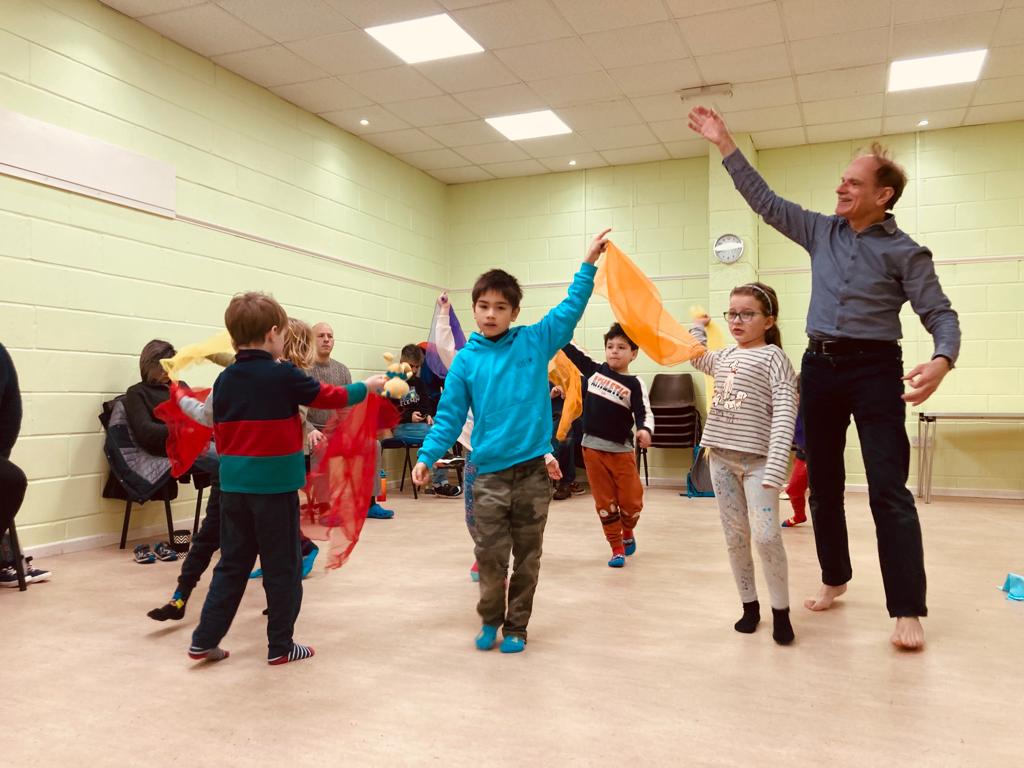
In our classes, children don’t just hear music — they sing it, move to it, feel it, and respond to it physically. Walking to a steady beat, stretching to a high sound, crouching for a low one, or flowing freely to music allows children to internalise musical ideas in a natural and meaningful way.
This approach reflects a simple truth: before music can live on a page or on an instrument, it must first live inside the child.
🎶 Why we begin with singing
The voice is the most natural and accessible musical instrument. Every child has one, and it develops alongside language. Singing helps children learn to control pitch, breathe naturally, and listen carefully to themselves and others.
Using initially simple folk and children’s songs, we develop the following in the children::
- Their sense of pitch becomes more accurate
- Their listening skills sharpen
- Their confidence in musical expression grows
Importantly, using the “thinking voice” we develop the child’s inner hearing—the ability to imagine sound before making it. This skill is essential for all musicians and underpins later success on any instrument.
Rather than rushing children toward an external instrument, we ensure that the musical instrument inside them is well tuned first.
🏃 Why movement matters just as much as sound
Music is organised movement in time. Children understand this instinctively. When they walk, skip, freeze, sway, or spin to music, they are not “just moving” — they are learning about pulse, phrasing, tempo, and expression.
Movement helps children:
- Feel a steady beat rather than count it
- Understand fast and slow physically
- Experience musical shape and flow
This bodily understanding makes rhythm secure and instinctive. Later, when children play an instrument, rhythm is no longer something abstract that has to be explained — it is something they already feel.
This principle lies at the heart of Dalcroze-inspired learning, where movement is not an add-on but a central pathway to musical understanding.
🤔 Building concentration and self-regulation
Many of the skills developed through music and movement transfer directly into everyday learning. In class, children practise starting and stopping together, responding to cues, and adjusting their actions in real time.
These activities support:
- Focus and attention
- Impulse control
- Emotional regulation
Because the learning is playful and embodied, children are engaged rather than pressured. They are learning how to concentrate without being told to concentrate.
🤹 Developing coordination and body awareness
Moving to music strengthens balance, coordination, and spatial awareness. Children learn where their bodies are in space and how to control them with increasing precision.
These abilities are closely linked to:
- Writing and fine motor skills
- Reading readiness
- Physical confidence
Music provides a joyful context in which these skills develop naturally.
🎵 Understanding patterns and structure
Music is full of patterns: long and short sounds, repeated phrases, rising and falling melodies. When children experience these patterns through song and movement, they begin to recognise structure and predict what comes next.
This supports:
- Early mathematical thinking
- Language development
- Memory and sequencing
Children are not being taught concepts explicitly — they are living inside them.
🎻 Preparing children for instrumental learning
A common question from parents is: “When will my child start learning an instrument?”
It is an understandable question — but it is worth reframing.
Children who have first developed:
- A strong sense of pulse
- Accurate pitch through singing
- Confident coordination
- The ability to listen and respond
are better prepared for instrumental lessons when the time comes.
They approach an instrument with:
- Greater musical understanding
- Less physical tension
- More confidence and enjoyment
Rather than struggling with rhythm or pitch at the same time as learning technique, these children can focus on the instrument itself — because the musical foundations are already secure.
In this way, our classes do not delay instrumental learning. They support it.
👥 Learning together: social and emotional growth
Making music in a group teaches children how to listen, take turns, and work together. Singing names, echoing phrases, and moving as a group build awareness of others and a sense of belonging.
Children learn:
- Cooperation
- Empathy
- Respect for shared space and sound
These experiences are just as valuable as the musical ones.
😊 Confidence, expression, and joy
Every small success — remembering a song, keeping a steady beat, inventing a movement — builds confidence. Music gives children a safe space to express themselves and to be seen and heard.
The laughter and energy in class are signs of deep learning taking place.
🎵 Inspiring young minds through the joy of music
At Education through Music, we believe that every child is musical. By starting with singing and movement—as advocated in the Kodály and Dalcroze traditions—we give children a rich, embodied understanding of music that supports both personal development and future instrumental learning.
When children sing, move, and play together, they are not just learning music.
They are learning how to listen, how to focus, how to express themselves — and how to learn.
Want to see the difference for yourself? Our Kodály-based children’s music classes in West Sussex run every Saturday in Emsworth, just minutes from Chichester and Havant. We also welcome families looking for Saturday music classes near Havant. Book a free taster session today.