What if one of the most powerful tools for your child’s brain was also one of the most joyful? Research consistently demonstrates a deep connection between music and early childhood development, with benefits extending far beyond learning a nursery rhyme. From sharpened memory and stronger executive function to better emotional regulation and richer social bonds, music is not simply an add-on to early education — it is one of its most potent engines for early childhood development.
Music Makes Children Smarter: The Cognitive Case
In a landmark 2004 study, psychologist E. Glenn Schellenberg followed 144 children over a year and found that those who received music lessons showed significantly greater increases in IQ scores compared to children in control groups — gains spanning verbal, reasoning, and attention skills. This was not a small effect; it was measured, replicated, and published in Psychological Science. Clearly, music plays a key role in supporting cognitive aspects of early childhood development.
Why does music do this? Learning to read rhythm and pitch, coordinate movement, and anticipate musical patterns all demand intense cognitive engagement. These activities strengthen working memory, the brain’s ability to hold and manipulate information — a skill directly linked to reading, mathematics, and problem-solving. Music is, in essence, a full-brain workout for young children that supports early childhood development.
Feeling It: Music and Emotional Regulation
Young children are often overwhelmed by big emotions they do not yet have the language to express. Music gives them another channel. In her comprehensive 2010 review, music education researcher Susan Hallam found robust evidence that musical participation improves emotional literacy, helping children identify, express, and manage their feelings more effectively. It makes sense that such growth in emotional skills is part of early childhood development.
Songs carry emotion — in their tempo, dynamics, and melodic shape. When a child sings a lullaby, acts out a stormy sea through movement, or taps out an angry rhythm on a drum, they are practising emotional regulation in the safest possible context: play. Over time, these experiences build the emotional vocabulary children need to navigate the wider world and lay the foundations for early childhood development.
Better Together: Social Skills Through Group Music
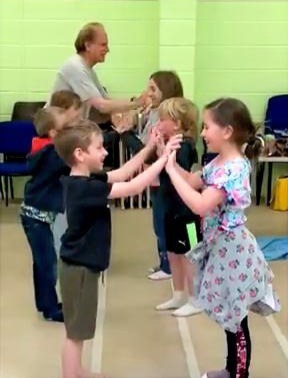
When children make music together, they are doing something remarkable: they are learning to listen. Group singing, clapping games, and ensemble activities require children to match their rhythm to others, respond to cues, and subordinate their individual impulse to the needs of the group. This process supports early childhood development by promoting empathy and cooperation.
Hallam’s 2010 research also identified consistent improvements in social behaviour and teamwork among children engaged in group music programmes. In our classes, we see this every week — the shy child who discovers confidence through shared song, or the boisterous one who learns patience through a call-and-response game. In fact, social skills acquired in music groups contribute strongly to early childhood development.
Move to the Music: Motor Development
The Dalcroze approach, central to our teaching, is built on the insight that rhythm lives in the body before it lives on the page. Clapping, marching, swaying, and dancing to music develops gross and fine motor skills simultaneously — coordination, balance, bilateral integration, and spatial awareness all improve through rhythmic movement activities. For children aged two to ten, this physical engagement is not just fun; it is developmentally essential for strong early childhood development.
3 Activities to Try at Home
You do not need instruments or training to support your child’s musical development. These simple, research-backed activities take only minutes and make a real difference. Incorporating music at home supports ongoing early childhood development.
- Steady Beat Together — While listening to any song, tap a steady beat on your knees — then invite your child to match you. Swap roles and follow their beat. This builds internal pulse, the rhythmic foundation of all musical learning, and strengthens listening and attention.
- Emotion Songs — Sing a short, familiar tune — then ask your child to sing it back “feeling happy”, “feeling sad”, or “feeling sneaky”. Changing the character of the song develops emotional literacy and musical expression at the same time. As an added bonus, these activities encourage early childhood development.
- Kitchen Percussion — Gather wooden spoons, pots, and plastic containers. Take turns leading a rhythm for the other to copy. Call-and-response games like this build memory, concentration, and turn-taking — the core of social musicianship and early childhood development.
Ready to Unlock Your Child’s Potential?
If you are looking for music classes for young children near Havant, Portsmouth, Southeast Hampshire or West Sussex, Education Through Music offers Kodály-inspired sessions for children from age 2 to age 10. Our classes are warm, structured, and deeply rooted in the research on how children actually learn. We put early childhood development at the heart of every session.
Every session is a step towards a more confident, curious, and connected child — and the evidence says it starts with a song. Additionally, early childhood development benefits greatly from consistent musical activities.
References
- Schellenberg, E. G. (2004). Music lessons enhance IQ. Psychological Science, 15(8), 511–554.
- Hallam, S. (2010). The power of music: Its impact on the intellectual, social and personal development of children and young people. International Journal of Music Education, 28(3), 269–289.