About Education through Music
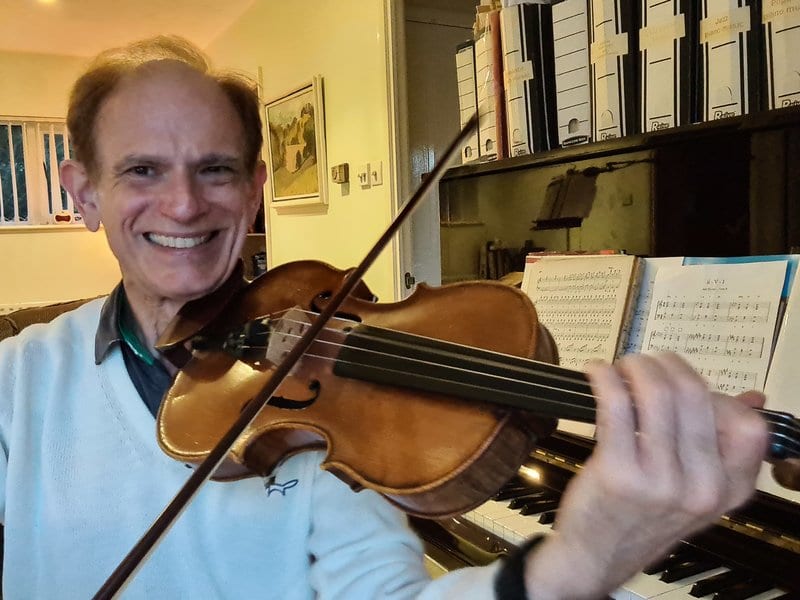
Education Through Music is an independent organisation. It was created in 2016 by Vincent Iyengar, a professional musician and qualified, Kodály-trained teacher in Hampshire, with many years of experience teaching class music in schools. He also teaches violin, viola, and piano.
Vincent set up the class to share the benefits of learning through music with children from two years of age onwards. He started the Musikids classes in 2017 at the request of a parent in Emsworth, who had been searching on the internet for a Kodály-trained teacher. He enjoys working with families to introduce the Kodály and Dalcroze teaching principles to very young children, helping them to develop a lifelong appreciation of music and supporting their overall development.
Meet Vincent Iyengar
Vincent originally graduated with an honours degree in mathematics and music from London University and received his postgraduate teaching qualification from Exeter University, with an additional Licentiate Diploma from Trinity College London.
After spending eight years teaching mathematics up to A level, he became Director of Music at St. Catherine’s British School in Athens, Greece. Returning to six years later, he went on to obtain a Master’s degree with distinction from Southampton University in philosophy of mind.
Subsequent posts were as Director of Music at Barfield School in Farnham and Hoebridge School in Woking.
In previous years, Vincent has been Musical Director of the Solent City Chorus, a male-voice close harmony choir, and has sung in Excelsis, a choir in north Surrey. He also occasionally sings for the St. Thomas-on-the-Bourne Church, Farnham, chamber choir when available.
Vincent plays piano and viola and very much enjoys playing in orchestral gigs. He plays for the Solent Symphony Orchestra, the Charity Symphony Orchestra at Romsey Abbey, the Botley Choral Society, and for other choirs and orchestras when needed.
Vincent has 12 years of experience as a general supply teacher in primary and secondary schools, and 17 years of experience teaching class music in primary age range schools, including 12 years teaching Early Years Foundation Stage music within schools. He is also a member of the professional body the Independent Society of Musicians (ISM).
When not kept busy with his lifelong passion for music, Vincent enjoys mountain trekking, travel, and learning foreign languages.
The Benefits of Music Education
Can music make an essential contribution to an individual’s education? Or is it just a luxury add-on? The answer is that music, when taught properly, definitely contributes to many different aspects of an individual’s education. Music is good enough for its own sake and does not need external justification. However, there are many other benefits, such as:
Our Philosophy
At Education through Music, we believe that music is for everyone, and every child deserves a joyful, creative, and inspiring start to their musical journey. Our unique approach combines proven methods that nurture musicality in a way that feels fun and natural for children.
The Kodály and Dalcroze Approaches to Music Learning
Kodály Principles
The Kodály concept is a wonderful and powerful child-centred approach to teaching and learning music. It is based on the principle of preparation, presentation and practice. Pupils spend time in activities (maybe for several months) which enable them to subconsciously internalise a musical concept before it is formally presented to them in terminology, written symbol, etc.
Great emphasis is placed on developing the “inner ear” through listening, singing and fun activities. This later leads on to reading and writing music and provides a solid foundation for understanding pulse, rhythm, melody, harmony, tonality, etc. Although people think of Kodály teaching as especially suitable for children, the Kodály approach can take pupils from babies right through to postgraduate level.
The Kodály method places singing at the heart of music education. Singing is a child’s first and most natural instrument, and through playful songs, hand signs, and rhythm games, we help children develop their ears for pitch and rhythm. This approach builds a strong foundation in musicianship, giving your child the skills they need to enjoy and create music for life.
Dalcroze Principles
The Hungarian composer, Kodály, who thought up the concept of the Kodály approach and its aims of producing a musical nation, was particularly impressed with the Dalcroze method, which predates Kodály.
The Dalcroze approach emphasises feeling the music (rhythm, pitch, structure, phrasing, etc.) before formally introducing the concepts. It has a strong emphasis on kinaesthetic learning. Broader than Kodály itself, in addition to building up the inner ear for pitch, rhythm, etc., it also develops in the student an understanding of tempo, dynamics, expressive phrasing etc.
Music is more than sound—it’s something we feel in our bodies. That’s why we incorporate movement into every class using the Dalcroze approach. Through dancing, stepping, and creative movement activities, children internalize rhythm and dynamics while also developing co-ordination, focus, and self-expression. It’s a hands-on, active way to truly live music.
Why These Methods Work
Engaging: Children learn through play, making music class the highlight of their week.
Holistic: By combining singing, listening, and moving, children develop their full musical potential.
Confidence-Building: Our activities foster teamwork, creativity, and self-assurance.
What This Means for Your Child
Your child will gain:
A strong sense of rhythm and melody
Confidence in expressing themselves through music
Co-ordination and listening skills
A lifelong love for music
At Education through Music, we blend tradition and innovation to create a warm, nurturing environment where every child can thrive musically. Come see the joy in action!